Growing Up In The Back of the Yards
Until I turned sixteen, home was 4636 South Ashland Avenue, in the heart of Chicago’s Back of the Yards neighborhood. It was a neighborhood built by immigrants and made infamous by Upton Sinclair’s The Jungle. The Jungle exposed the brutal conditions of the Stock Yards at the turn of the 20th Century. For nearly 100 years, from the mid 1800’s to the mid 1900’s, those stockyards defined this part of Chicago, drawing workers from all over the world to toil in what must have felt like a vision of hell.
By the time I was born in the early 1960s, the Stock Yards were fading away, but the Back of the Yards remained a landing place for new immigrants. The Irish and Germans who once filled its streets had mostly moved on, replaced by waves of newcomers from Mexico and Eastern Europe. I remember hearing as a kid that Chicago’s Polish population was second only to Warsaw, and I wouldn’t be surprised if the Mexican population was second only to Mexico City.
Though the stockyards no longer lured immigrants in droves, Chicago’s location—crisscrossed by rail lines and industry—still made it a magnet for those seeking work. Manufacturing jobs, often unionized, provided a path to stability, even for those arriving with little more than hope. My own family, with its roots in Mexico was part of that cycle.
My Family
My father, Jorge, spent the last 20 or so years of full-time employment working at the Continental Can Company, one of the major canning operations in Chicago. For decades, he maintained and repaired the machines that kept the factory running, a job that was as vital as it was dangerous.
Even in a union shop, accidents happened—once, hot oil burned his chest so badly that he carried a long, wide scar on his chest for the rest of his life. When the factory shut down in the seventies, he took early retirement, closing a chapter in his life of steady, blue-collar manufacturing work that had supported our family.
My mother, Amada, kept everything together at home. She raised seven of us. George, Nena, Licha, Bobby, and Sylvia, were my older siblings. We were all spaced about 2 years apart. The exception was my younger brother Michael who was four years my junior.
Our mom was mostly a stay-at-home mom until I was eight when she took a job as a teacher’s aide at a nearby public grammar school. With so many kids and my father working the 2nd shift (from 2pm to midnight) her hands were always full, and her patience stretched to the limit.
Our Apartment
For the first sixteen years of my life, our home was a second-floor apartment above Jack’s Army Store on Ashland Avenue, between 46th and 47th Street. Like many buildings in our neighborhood, the ground floor housed businesses— a store, a small restaurant, an accountant’s office —while families lived above.
With three bedrooms and two large living spaces — one facing Ashland Avenue, the other at the back—it was surprisingly spacious. Years later, I measured it using Google Earth and found it was at least 2,500 square feet—more than my current four-bedroom, three-bath home in San Francisco.
The living room was huge and positioned at the front of the apartment which faced Ashland Avenue. We simply called it the “Front Room”. It served many purposes over the years. It performed it’s intended function as a place to watch TV. But half of it also served as the “piano room”, with an old church piano where my sister Nena practiced. Eventually, that second half became an ad-hoc bedroom for my oldest brother George.
The long hallway that ran through the middle of the apartment functioned as the center of our inside playground. It was wide enough for roller skating, bowling, and even bike riding. At the very back of our house was a room of equal size to the living room. We called that space, you guessed it, the “Back Room”.
This room was a multi-purpose space just like the living room. First it was where we ate our meals. Second, it was our laundry room. We had a big double wide tub sink made of cement in that room. An old-fashioned ringer washing machine sat right next to that sink.
For many years we didn’t have a dryer, so everything was hung dry. Not too much of a problem in the summer but less than ideal in the cold winters of Chicago. In the last few years of our time on Ashland, half of the Front Room was turned into an ad hoc bedroom for my older brother Bobby.
Three actual bedrooms, a single bathroom, multiple closet spaces, and a small kitchen were spread throughout the house – all positioned off the long hallway. My parents’ bedroom was at the front of the house with windows facing out onto Ashland Avenue. My sisters shared a large interior bedroom with three side by side beds.
I shared a room with my two older brothers (George and Bobby) until my younger brother came along. Once he came along, my younger brother moved into the bedroom and George moved into the ad-hoc bedroom in the Front Room. A few years later Bobby moved into an ad-hoc bedroom – this one created by partitioning the Back Room. At that point it was just me and younger brother Michael sharing the room. We fought like cats and dogs.
The Parking Lot
The Back Room opened onto a porch where we kept all of our bikes, balls and anything else we used to play outside. It was semi-dilapidated and had a noticeable downward slant from the doorway to the front of the porch. This is where we kept our bikes, all manner of balls and anything else we needed to play outside.
The porch had a twisting staircase that would take you down to a small back yard that opened out into the alley way. Across the alley was public parking lot that consumed the majority of the other side of the block. The lot provided off street parking for the shoppers headed to stores on either Ashland Avenue of 47th Street.
This parking lot was also the center of our outdoor life when I was of grade school age. The entire neighborhood used it as a playground. In the summer, fall and spring we would regularly play fast pitch and football in the parking lot. We would also ride our bikes here going around and around it as if it were the Indy 500.
In the winter, the city’s snowplows would pile up snow in the four corners of the parking lot and we would dig out tunnels and forts in these 15 x 15 feet wide and 10-foot-high mountains. We also use carboard to sled down these man-made peaks. Playing “war” was an all-season sport in the parking lot as well.
My First Real Job
Every boy in our family except for my younger brother had as their first money making adventure working as a paper boy delivering both the Chicago Sun Times and the Chicago Tribune. But once you got a bit older, you could count on being offered an opportunity to work downstairs in our landlords Army surplus store.
I don’t know what the child labor laws were back then but I’m pretty sure neither I nor my brothers were old enough to legally hold a store clerk job. However, it was pretty commonplace in those days for underage minors to take off the book jobs that paid you cash under the table. We each worked there a summer or two and then moved on to something better. No withholding but definitely below minimum wage.
I’ll never forget that dusty old store loaded with inventory that hadn’t moved in many a year. I have no idea how they stayed in business with as few sales as we made in a day.
Looking Back
We moved away from the back yards when I was sixteen. My dad had finally saved up enough money for a down payment on small cottage style house in another nearby neighborhood. It was only about 3 miles away, but it might as well have been on the other side of the world.
By the time we moved, the parking lot was no longer the center of the world for me. Nor was the public park nearest our home, Davis Square, where I spent a lot of time as a young teenager.
Eventually, I moved away from the Southside of Chicago to the Northside of the city. Later, I and my future bride left Chicago entirely and resettled in California. My parents and my siblings eventually also moved away from the Southside of Chicago. Mostly to live in the Southwest Suburbs.
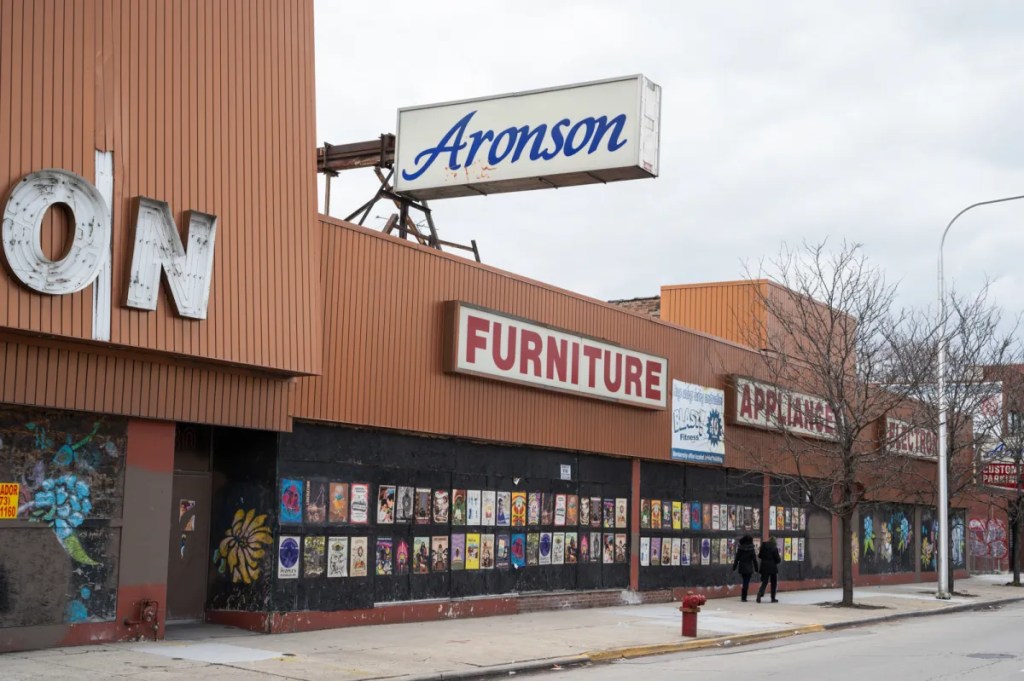
For along time I would visit family yearly but rarely visited the old neighborhood which had changed radically by then. There was no one left to visit and the apartment we had lived in was no more. A number of separate stores, including the Army store below our apartment, had been consolidated into a much larger furniture store with the above apartments converted into storage space that were no longer accessible from the street.
My father passed away right before the worst of COVID hit the US. My mom had passed some ten years before this. I was lucky enough to be at his bedside when he passed for which I am eternally grateful. After he passed, I returned to his current apartment in the Southwest Suburbs for one night before I could catch a flight back to California. I spent time that evening looking at pictures he had in albums from the period when we were kids.
In a drawer by his bed, I found the initial lease that he signed way back when he first moved our family to the apartment on Ashland Avenue so many years earlier. I have no idea why this was in the drawer by his bed. The lease itemized a rent of $63 per month. I’m sure that amount of rent was a stretch for my parents back then, but I can’t imagine trying to raise seven children today on the kind of money my dad made back then.
In the weeks after I returned to San Francisco, I became aware of a strange new phenomenon taking place on my block that reminded me of my childhood. During those early days of COVID, the neighborhood kids discovered that they could actually play outside with other kids. Up until this point I had never seen any of the kids that lived in our neighborhood playing together outside.
I thought to myself how lucky those kids were to be able to actually experience the joy of just hanging out and playing outside with the other kids that lived nearby. That is exactly how I grew up. Spring, summer, fall or winter, if I wasn’t in school, I was outside in that parking lot or spending time at Davis Square Park. Playing alongside the other kids from my neighborhood. Staying out until the sun was waning, and we heard our mom’s calling us home for dinner.

 David Jasso
Leave a comment